

Used Commercial Kitchen Equipment: What Yours Is Worth and How to Move It
What used commercial kitchen equipment is worth in 2026, how to sort a kitchen into sell, spares and scrap, and what it costs to move it. UK seller guide.
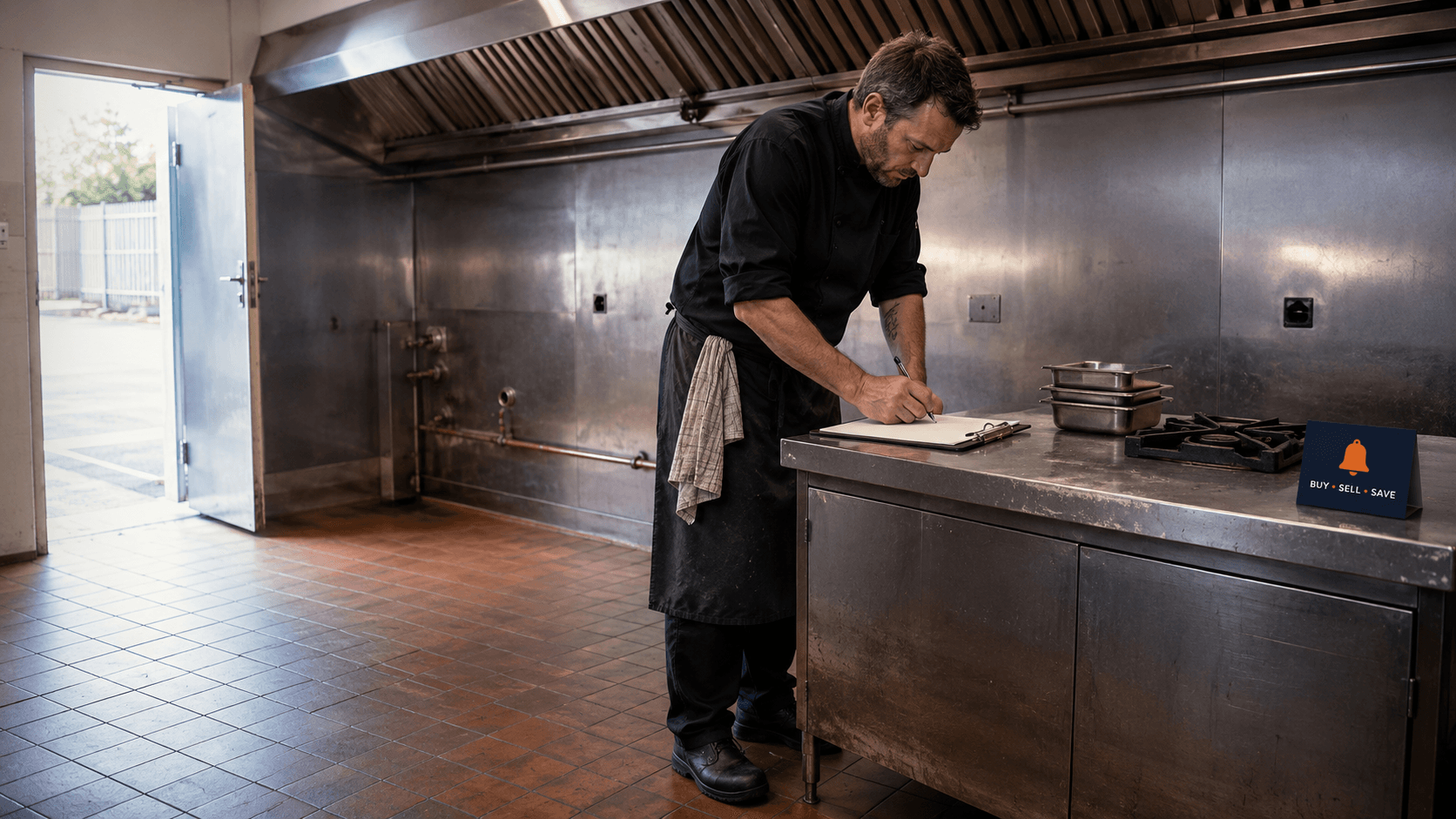
photograph it in the kitchen, plugged in and clean. On a pallet in a yard it reads as scrap and gets scrap offers. Data plate, service history, switched on, before the engineer comes.
Most operators find out what their kitchen is worth at the worst possible moment. The lease is up, the unit has to be clear by Friday, and someone offers to take the lot away for nothing.
That is not a valuation. That is a clearance.
There are a lot of kitchens being cleared at the moment. Government figures put accommodation and food service insolvencies at 762 in the first quarter of 2026, running consistently above 250 a month, and that means two things for anyone selling: there is more used kit moving than usual, and the operators handling it are usually doing it under time pressure and for the first time.
Used commercial kitchen equipment holds real money, and the gap between what a kitchen is worth and what it gets sold for is almost always down to three things: not knowing the floor price, not knowing what drives the number above it, and not leaving enough time. This is the seller's guide to all three. I spent twenty five years in commercial kitchens before I built this marketplace, fabricating stainless, installing it and signing off the gas, so most of what follows is what I would tell you stood in your kitchen with a tape measure.
Scrap Is the Floor, Not the Price
Start with the floor, because it stops you accepting nothing.
Almost every machine in a commercial kitchen has a stainless steel body, and stainless is not scrap iron. As of 17 August 2026, UK yards were averaging £0.529 per kg for 304 stainless, which is the grade most kitchen kit is built from, and £1.13 per kg for 316. Light iron on the same day was £0.080 per kg, and cast iron £0.155.
Read those two numbers next to each other. Stainless is worth roughly six and a half times light iron per kilo. So an example calculation, using that published rate: a stainless prep table weighing 45kg, sold as 304, is around £24 of metal. The same table weighed in as light iron is about £3.60.
That is the single most common way operators lose money on a clearance, and it happens quietly, on a weighbridge, with no argument. If metal is leaving your kitchen, it goes as what it actually is.
Two honest caveats. A yard will pay under the published index, because the index is the market and the yard is a business. And they will deduct for what is bolted to the stainless: motors, compressors, insulation, plastic, glass. A fridge is not 100kg of stainless, it is a stainless skin over a lot of other material.
None of which changes the point. Scrap is the number below which you should never sell, not the number you should be aiming at. A working machine is worth a multiple of its metal, and the rest of this post is about protecting that multiple. For the disposal side of it, where the kit genuinely is finished and there are legal duties attached, that is its own subject: read what to do with old catering equipment.
The Four Things That Set the Price
After twenty five years of pricing this stuff, it comes down to four questions, in this order.
The badge. A machine from a manufacturer with a UK parts network and engineers who know it is worth substantially more than an identical looking machine from a brand that has left the market, because the buyer is not buying a box, they are buying the ability to get it fixed on a Friday night. Rational, Foster, Williams, Hobart, Falcon, Lincat, Blue Seal, Unox: these names do work on a listing.
Whether parts are still available. This is the badge question made specific, and it is the one buyers actually check. A machine with no obtainable parts has a ceiling on it no matter how clean it looks.
Condition, and whether you can prove it. Not how it looks in a photograph. Service history, a recent gas certificate, seals that seat, an element that draws what it should. Proof is worth money because it removes the buyer's risk, and removing risk is the only reason anyone pays more than the cheapest option in front of them.
How hard it is to get out of your building. A countertop machine and a fitted item are different products even at the same age and condition. More on that below, because it is where deals fall over.
What those four questions mean varies by machine, and that is what the individual guides are for. If you are pricing a fryer, work through the used commercial fryer buying checklist, because the checks a buyer will make are the checks that set your price. Same for a used commercial combi oven, for used commercial refrigeration, for a used commercial dishwasher, and for commercial food preparation equipment. Read the guide for the machine in front of you before you put a number on it.
Sort the Kitchen Into Three Piles
Before you photograph anything, walk the kitchen with a pad and put every item into one of three piles. This is the part people skip and it is the part that makes the money.
Sell whole. It works, or it works with a cheap known fix, and parts are available. This is where nearly all the value sits, so be generous with this pile. Plenty of kit that looks tired is a seal, a thermostat or a good clean away from being a sound machine.
Sell for spares or repair. It does not work and it is not worth fixing for you, but it is worth something to someone who wants the motor, the door, the compressor or the frame. This pile is routinely thrown away and it should not be. Be plain in the listing that it is spares or repair, because a buyer who is misled once never comes back, and the trade is small.
Weigh in. Genuinely finished, no usable parts, nothing left but the metal. Now go back to the section above and make sure it goes as stainless.
If this is a full closure or a downsizing rather than a couple of machines, the sequencing matters more than anything else and it has its own guide: closing or downsizing a kitchen.
Getting It Out of the Building
This is my old trade, and it is where I see sales collapse after the price has been agreed.
Disconnection comes first, and it is not your job. Gas has to be capped off by a Gas Safe registered engineer. Three phase gets isolated by an electrician. Refrigeration on a split system needs the gas recovering by an F-gas certificate holder before anything is disconnected. Book that in before you agree a collection date, not after, because a buyer stood in your car park while you ring round for an engineer is a buyer who starts renegotiating.
Measure the route, not the machine. I have watched a perfectly good combi get as far as a doorway and no further. Measure the machine, then measure every door, corridor, turn and step between it and the vehicle, and check whether it comes apart. Feet, handles and doors often come off and buy you the inches.
Know the weight before you promise anything. Commercial kit is heavier than it looks, and the weight decides whether it goes on a pallet, needs a tail lift, or needs two people and a stair climber. Get it wrong and the haulier turns up with the wrong vehicle.
Price the delivery honestly into the deal. UK pallet rates in 2026 run roughly £45 to £90 for a full pallet nationally, £35 to £60 for a half and £25 to £45 for a quarter, with surcharges on top for a tail lift, a timed slot or an awkward postcode. That is real money on a machine worth a couple of hundred pounds, so decide up front whether the price is collection only or delivered, and say which in the listing.
Wrap it like it is going to be dropped. Heavy duty clear stretch film round the machine and the pallet deck so the two become one object, cardboard corner boards under the film on the edges, and the label on the outside of the wrap where a driver can read it.
Listing It So It Sells
Two things decide whether a listing sells: whether a buyer can find it, and whether they can trust it.
Findable means the brand, the model and the machine type in the title, in the words the trade actually uses. Trustworthy means honest photographs including the tired corner, the actual condition stated plainly, dimensions and weight, whether it is working or spares, and whether the price includes delivery.
That is a lot of typing for one machine, let alone twenty, which is why we built CaterBot. Upload your photos and it writes the listing: brand, model, type, dimensions, weight, power, capacity, condition and the full description. It is AI assisted rather than perfect, and it is free to use on every plan at launch, so it works the same on a single listing as it does for a dealer loading thirty.
Then there is what it costs you to sell. On eBay's Business, Office and Industrial category the published rates as of March 2026 are a 12.5% final value fee, a £0.40 order fee and a regulatory operating fee of roughly 0.35%, all before VAT. An example calculation on a £2,000 oven at those rates is around £257 before VAT, taken out of your sale. On CaterBids there is no cut of your sale at all. You pay to list: the first 100 listings on the platform are free, and after that it is from £5. On a £2,000 oven that is the whole comparison in one line. The full breakdown across every channel is in what it actually costs to sell commercial catering equipment, and if you are still deciding where to put it, where to sell used catering equipment walks through the options.
Worth saying plainly: CaterBids is in beta. It is UK only, it is commercial kitchen equipment only, and the sellers listing now are the early ones. That is the honest position and it is also the argument, because a buyer browsing a specialist marketplace is looking for exactly what you are selling.
The Checklist Before You Move Anything
- Walk the kitchen and put every item in one of the three piles
- Check parts availability on anything you are calling a working machine
- Dig out service history, gas certificates and manuals, and photograph them
- Weigh and measure every item, and measure the route out of the building
- Book the gas, electrical or F-gas disconnection before you agree any collection date
- Get a pallet quote so you know whether you are selling collection only or delivered
- Photograph in daylight, including the damage
- Price above the scrap floor, and know what that floor is per kilo of stainless
BUY • SELL • SAVE
A commercial kitchen is not a pile of scrap with a few good bits in it. It is a set of machines, each with its own buyer, and the difference between a clearance and a sale is a fortnight of work and a tape measure. Know the floor, protect the multiple, and sell the machines to the people who want them.
Ready to Sell?
List your equipment on CaterBids. The first 100 listings on the platform are free, then it is from £5, and there is no cut of your sale either way. Or if you are the one fitting out rather than clearing out, browse the marketplace.
Ready to Sell Your Equipment?
Free to list while the first hundred listings are running, then from £5 a listing, and no final value fee at any point, so what a seller makes is what they keep.
Prepare Your Equipment
- Clean stainless surfaces
- Disconnect safely
- Photograph the data plate
- Box loose parts
- Measure and weigh
- Prepare for pallet collection