

Buying and Selling a Used Commercial Dishwasher: The UK Warewashing Guide
What to check on a used commercial dishwasher or glasswasher: limescale, rinse temperature, phase and water softener history. Sell with zero final value fees.
Buying and Selling a Used Commercial Dishwasher: The UK Warewashing Guide
Warewashing is the machine nobody thinks about until it stops. Then it becomes the most important thing in the building, because a kitchen with no clean plates stops serving.
It is also the used category with the widest gap between a bargain and a liability. Two machines can look identical, same model, same age, same tidy stainless box, and one has years left in it while the other is scrap with a plug on. The difference is almost always water.
Here is what to check before you buy one, and what to tell buyers when you sell one.
Know Which Machine You Are Looking At
Three types cover nearly everything in the UK trade.
Undercounter machines. A square stainless box roughly 600mm across that slides under a counter, with a drop-down front door and a small control panel in one corner. Glasswashers and small dishwashers both live here. Right for a bar, a café or a small kitchen.
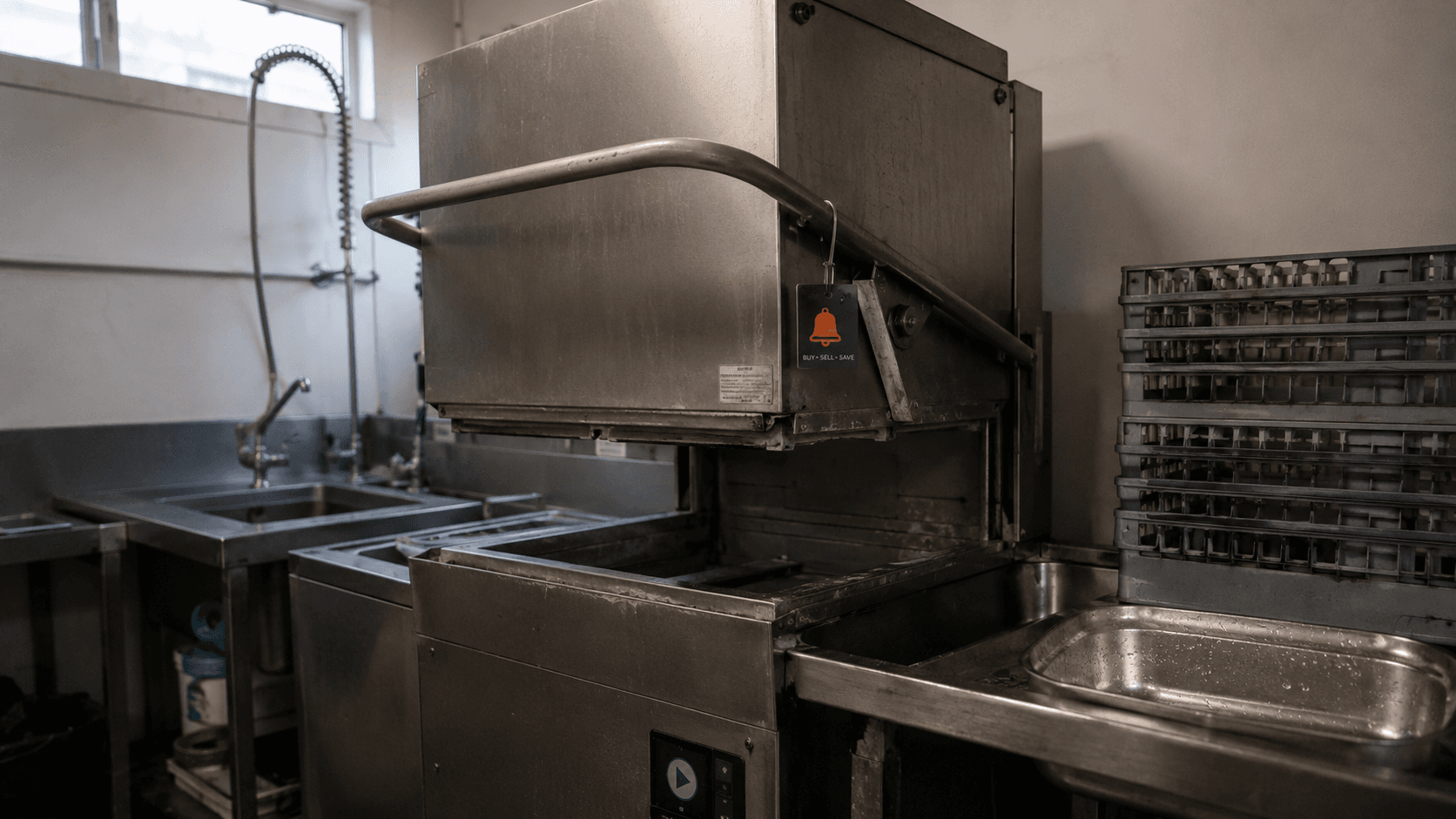
Passthrough hood machines. The big square hood that lifts vertically over the wash chamber, sitting on a tabling run with a sink one side and a clean rack rail the other. This is the workhorse of most restaurant kitchens. It needs the tabling either side to work properly, which matters when you are buying: a hood machine on its own with no tabling is only half a solution.
Rack conveyors. High volume, big money, and a different conversation. If you are buying one of these you already know what you are doing.
Names worth knowing in the used market: Winterhalter, Hobart, Classeq and Meiko. They hold value because parts and engineers are easy to find. An unknown import may be cheaper up front and impossible to get a pump for in two years.
The One Thing That Kills Them: Limescale
Most of England sits in a hard water area, and warewashers boil water all day. Without treatment, limescale builds on the heating elements, the wash arms and the internal surfaces until the machine works harder, washes worse and eventually fails.
The damage does not stop at performance. Scale leads to corrosion, and boiler and rinse tank leaks that follow are usually terminal, because replacing the tank costs more than the machine is worth secondhand.
So the first question on any used warewasher is not "does it run". It is "was it on softened water?"
Ask it directly:
Was there a water softener, integral or external, fitted to the supply?
If it was a manual softener, was anyone actually putting salt in it? A softener nobody regenerated is a softener in name only.
When was it last descaled? Six months is the normal minimum interval, more often in hard water.
Is there any service history at all?
A machine from a soft water area, or one with a softener and a service record, is worth notably more than the same model from a hard water site with no history. If the seller cannot answer any of it, price the machine as though the answer was no.
What To Check Before You Hand Over Money
Get it running if you possibly can, and if it cannot be run, buy it as spares or repairs and pay accordingly.
Look inside first. Open the door and look at the wash chamber. Chalky white deposits on the elements, the arms or the walls tell you the scale story before the seller does. Rust streaks in the tank are a bad sign, not a cosmetic one.
Spin the wash arms by hand. They should turn freely. Then look at the jets: blocked or enlarged holes mean scale and poor wash results.
Check the rinse temperature reaches the mark. A commercial rinse should hit around 82°C. That is what sanitises, and it is what an environmental health officer expects. A machine that will not get its rinse up to temperature is not fit for a commercial kitchen, however clean it looks.
Pull the filters and the drain out. Damaged, warped or missing filters are cheap to replace but tell you how the machine was treated. Standing water in the base that will not clear points at the drain pump.
Check the door seal all the way round. Perished or flattened gaskets leak onto the floor, and on a hood machine a bad seal means steam in the room.
Read the data plate. The sticker inside the door or round the back with model and serial on it. That tells you the true model and the electrical supply, which is the next thing.
Confirm the power. Plenty of commercial warewashers are three-phase. If your site is single-phase only, a three-phase machine is not a bargain, it is a paperweight. If you are unclear on the difference, our guide on 3-phase versus single-phase equipment covers it.
Check the drainage arrangement. These discharge through an air gap or tundish so there is no back-siphon risk, and they need a gully that falls the right way. Worth knowing before you buy, not after.
What A Used One Is Worth
Value tracks three things, in this order: the brand, the water history, and whether it runs.
A known brand undercounter machine in working order with a softener history is the strong end of the market. The same machine with no history, unproven, from a hard water area is worth a fraction of it, because the buyer is taking on an unknown boiler.
The two cheapest machines on any listing site are usually the same two stories: a heavily scaled unit from a hard water site, and a three-phase machine being sold to a single-phase market. Both are cheap for a reason.
Rather than quote figures that go stale, be guided by the age-band approach in our used commercial refrigeration guide, which applies to most categories: condition and provenance move the price far more than age alone.
Selling One: What Buyers Actually Want To Know
Sellers lose money on warewashers by listing them like a plain stainless box. Buyers of this category are nervous, and for good reason, so the listing that answers the nervous questions gets the enquiries.
Say these things plainly:
The water story. Softener fitted or not, and whether it was maintained. If it was on softened water, that is your headline. It is the single most valuable fact about the machine.
The last descale, and any service history. Even a rough date beats silence.
Whether it has been seen running, and at what rinse temperature if you know it.
Single-phase or three-phase, stated up front. It saves both of you a wasted journey.
Whether tabling is included on a hood machine, and what size.
Any fault, named honestly. "Drain pump noisy" priced accordingly sells faster than a vague listing that dies on collection.
Photograph the data plate. On CaterBids, CaterBot reads that photo and fills in the brand, model, power type, dimensions and weight, and gives you a pallet delivery recommendation off the back of it, so the listing takes minutes rather than an evening. Then photograph the inside of the wash chamber. A clean chamber is your proof, and a buyer who can see it will pay for it.
The Short Version
Three types: undercounter, passthrough hood, rack conveyor. Buy the one your room and your volume actually need.
Limescale is what kills these machines. Ask about the water softener before you ask anything else.
Look inside: chalky elements and rusty tanks are the tell.
Rinse must reach around 82°C. That is the hygiene line.
Check single-phase or three-phase before you buy, not after.
Selling? Lead with the water history and the service record. That is what buyers are afraid of, so answering it is what sells the machine.
Good warewashing kit sold honestly moves quickly, because everyone in this trade knows what a dead dishwasher costs them on a Friday night. List it fixed price, keep what it sells for. BUY, SELL, SAVE.
Always have commercial electrical and plumbing connections carried out by a competent registered person. This guide covers what to check as a buyer or seller, not how to install.
Ready to Sell Your Equipment?
Free to list while the first hundred listings are running, then from £5 a listing, and no final value fee at any point, so what a seller makes is what they keep.
Prepare Your Equipment
- Clean stainless surfaces
- Disconnect safely
- Photograph the data plate
- Box loose parts
- Measure and weigh
- Prepare for pallet collection