

Buying a Used Hot Food Display Cabinet: What to Check Before You Buy
Buying a used hot food display cabinet? The 63C rule, wet heat vs dry heat, what the rating plate tells you, and the parts that fail. CaterBids.uk
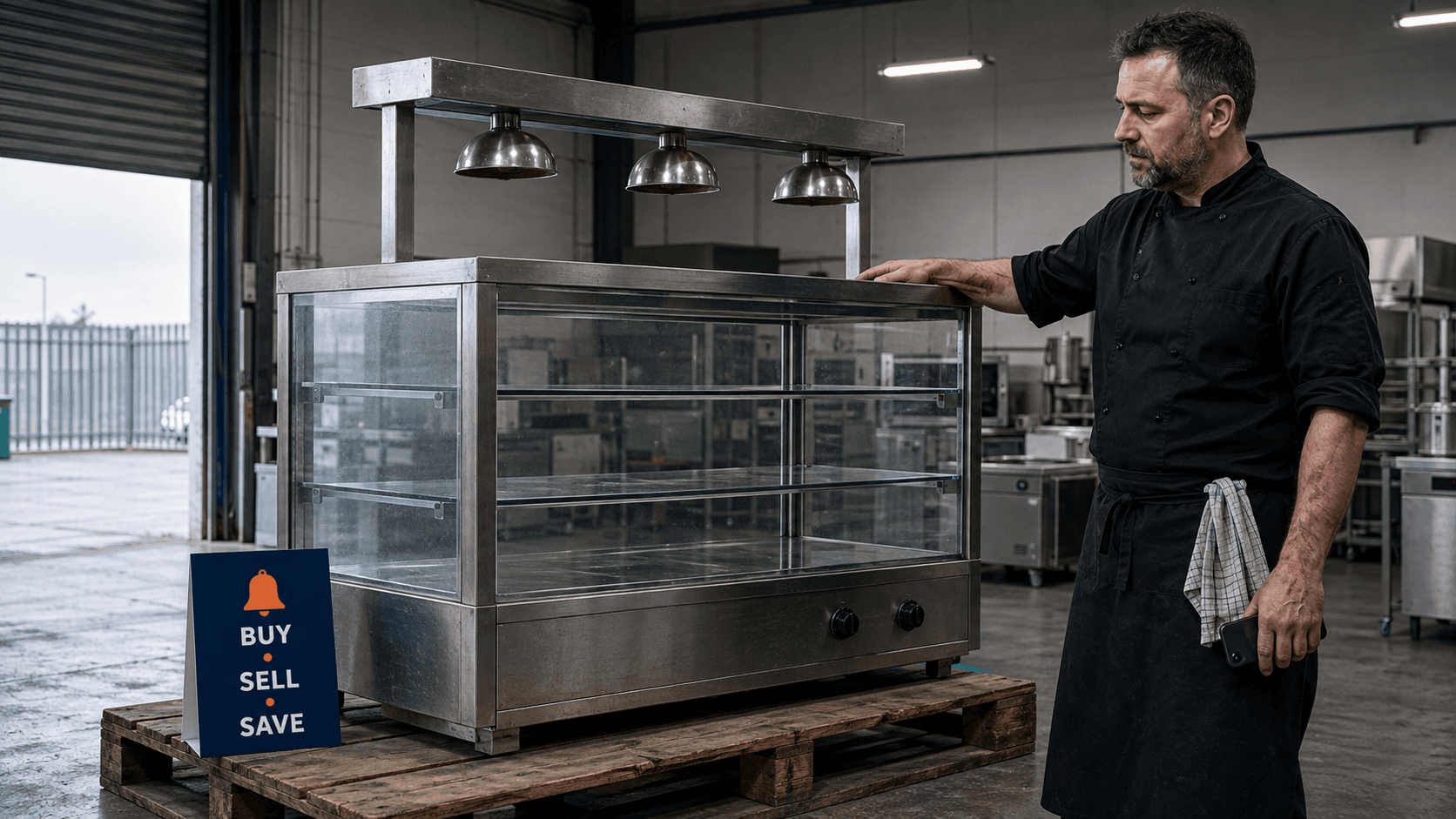
Check the rating plate against the socket before you check the price. Anything over 3kW needs an electrician, and a cheap carvery unit can cost more to connect than it did to buy.
There is a myth in the trade that some hot display cabinets are compliant and some are not. That is not how the law works, and understanding why saves you money.
In England, Wales and Northern Ireland the offence is committed by the person keeping cooked food for service or on display below 63°C. The duty attaches to the food, not the machine. So no cabinet is legal or illegal in itself. What matters is whether that cabinet can hold what you actually sell, at 63°C or above, all the way through, in the room where it will live.
That single reframing is the whole buying guide. Everything below is how you work out whether a used unit can do it.
Scotland Is Different, and Almost Nobody Says So
Two differences worth knowing before you buy anything, especially if you are buying across the border.
The rest of the UK has a defence for food held below 63°C: it must have been on display for less than two hours, and it must not have previously been kept for service or on display by you. That is once. Not twice, not once per session. After that the food is reheated until steaming hot, chilled to 8°C or below, or thrown away.
Scotland has no equivalent. The Scottish regulations are structured completely differently and carry no two-hour tolerance at all. Scotland also has a reheating rule the rest of the UK does not: food reheated before service must be raised to not less than 82°C.
If you run sites either side of the border, the same cabinet and the same routine will not do.
Wet Heat or Dry Heat: Decide This Before You Look at Price
This is the decision that makes a used cabinet either a bargain or an expensive mistake, and it costs nothing to get right.
Dry heat is a heated base with radiant or convected air and no water. It is the correct choice for anything that has to stay crisp: pasties, sausage rolls, fried chicken, roast potatoes, puff pastry. Over an hour or two it will dehydrate anything that is not crisp by design, and a sauced dish will skin over.
Wet heat, a bain marie style unit with a water well, holds a steam-rich atmosphere. It is the correct choice for curries, sauced proteins, rotisserie chicken and anything that dries out. Put pastry in one and it is ruined in minutes.
A dry cabinet full of curry and a wet cabinet full of pasties are both the wrong purchase, however cheap. Work out what sits in it for two hours on your busiest day, and buy for that.
One practical difference worth knowing on service timings: one UK manufacturer, Café Counters, publishes warm-up times of roughly 10 to 15 minutes for dry heat against 25 to 45 minutes for wet heat to stabilise. That is their figure rather than an independent test, but the direction is right and it changes what time you switch on.
Gantries and overhead heat lamps are a different animal again. They are open radiant top heat over a pass or a carvery, with no enclosure and no humidity control at all. Hatco, who make them, describe their merchandising warmers as designed for short-term holding. They are for minutes, not hours, and a gantry is not a substitute for a cabinet.
Read the Rating Plate Before You Read the Price Tag
The single most expensive mistake on used heated display is buying a machine you cannot plug in.
Counter-top units are generally straightforward. A Buffalo CD231 countertop merchandiser is 1.1kW at 230V, 4.75 amps, and ships with a UK plug. A Victor DED50100 double hot lamp gantry is 1.3kW and comes with a two metre lead and a 13 amp plug. A Lincat Seal LD3 counter-top with gantry is 2.4kW single phase.
Above that it changes fast. Lincat's own Panther hot cupboard manual states that all appliances with an electrical loading over 3kW must be connected to the supply by a qualified electrician. A Lincat P8B4 free-standing hot cupboard with bain marie top is 4.9kW, which at 230V is roughly 21 amps, well beyond a 13 amp socket. A Roto Quip RHCW-4 chicken warmer is 3.5kW on 380V three phase.
So: photograph the rating plate, work out the load, and check it against the socket you actually have before you agree a price. A big carvery or multideck bought cheap can cost more in a dedicated supply than it did to buy. If you are unsure what your kitchen has, our guide to three phase and single phase catering equipment covers how to tell.
What Actually Fails, and What It Costs
Used heated display fails in a small number of predictable places, and the good news is that most of them are cheap.
Heating elements are the number one item. On the UK parts market a Victor 900W element is about £24, a 1kW element about £54, and a 3kW submerged bain marie element about £149. That last one is the expensive lesson: a submerged element that has been run dry, or run for years on hard water, is the priciest single part on the machine.
Thermostats and controllers are second. Victor hot cupboard thermostats run roughly £22 to £46. Café Counters advise that mechanical thermostats can drift by a few degrees over six months of heavy use and suggest a monthly calibration check, which is their guidance rather than a standard, but a used unit whose thermostat has never been checked is a unit you cannot trust at 63°C.
Gantry lamps are consumables by design. Victor describe theirs as operator changeable infrared bulbs, so a dead lamp is a five minute job, not a fault.
Glass and seals are a real cost. Counterline list glass as one of their four standing spare parts categories, which tells you how often it needs replacing.
Limescale in the water well is the killer on wet heat units. Lincat's own manual says the water well should be emptied at regular intervals using the drainage tap and refilled with fresh water. On a used unit in a hard water area, look in the well. A furred-up well and a stained element tell you how the last owner treated it, and they predict the next failure better than the outside of the machine does.
Buy a Badge With a Parts Network Behind It
The same rule that governs every other category applies here, and there are more UK manufacturers in heated display than most people realise.
Genuinely UK-made: Victor in Keighley, Lincat in Lincoln (including the Seal counter range), E&R Moffat in Bonnybridge, King Edward in Herefordshire, Counterline on Merseyside, Roto Quip in Bradford.
Sold widely in the UK but made elsewhere: Roller Grill is French, Hatco is American.
And one trap worth knowing. Moffat and E&R Moffat are two different companies. Moffat is an Ali Group brand with an Australian head office and New Zealand manufacture, whose UK arm is Blue Seal in Birmingham. E&R Moffat is a separate Scottish manufacturer in Bonnybridge. Used listings say "Moffat" without distinguishing, and it changes who you ring for parts.
On parts routes: Lincat spares in the UK and Ireland go through Parts Town UK as exclusive distributor, and Victor parts are carried by independent stockists like CaterSparesUK. Both are easy to check before you buy, which is exactly why parts availability is the first thing to look at on any used machine.
What It Should Cost
For context on new: a Buffalo CD231 countertop is around £566 ex VAT, a Lincat Seal SCH1085 around £1,620, and a Moffat Go-M multi-zonal up around £3,838 to £6,413.
On the used market, UK dealers currently list hot cupboards and bain maries from about £100 for a small counter-top unit up to about £1,000 for a hot cupboard with a bain marie and a heated gantry, with a used Moffat hot top servery with heated gantry listed at £650 plus VAT.
Set that against the repair costs above and the arithmetic is usually easy. A £650 used unit that needs a £149 element and a £45 thermostat is still a good buy. A £650 unit with a scaled well, a drifting stat and no parts network behind the badge is not.
One Thing the Inspection Will Cost You
Worth knowing before you buy on price alone. Under the Food Hygiene Rating Scheme, no single element can score above the top band if you want a rating of 5. Hot holding sits in the food safety and hygiene compliance element. So a cabinet that cannot hold 63°C, caught on the day, can cost you the five on its own with everything else in the kitchen spotless.
Penalties for the underlying offence are not trivial either: on summary conviction a fine, and on indictment up to two years.
One admin note while we are here: the Food Standards Agency moved its entire website onto GOV.UK on 25 June 2026, so if your food safety folder has bookmarked FSA pages or a saved Safer Food Better Business pack, those links are dead. Worth ten minutes refreshing them.
The Checklist for a Used Hot Display Cabinet
- What sits in it for two hours on your busiest day? Wet heat or dry heat follows from that answer
- Photograph the rating plate: kW, voltage, phase. Check it against the socket you have
- Over 3kW, budget for an electrician before you agree the price
- Open the water well on any wet heat unit and look at the scale and the element
- Run it up and probe it. It must hold 63°C or above, loaded, in the room it will live in
- Check the badge has a UK parts network behind it, and confirm which Moffat you are looking at
- Check the glass, the seals and the gantry lamps, and price the replacements before you offer
BUY • SELL • SAVE
A heated display cabinet is a simple machine: a box, an element, a stat and some glass. Bought on the right badge and checked properly, a used one will outlast the business that sells it to you. Bought on price alone, it becomes the reason an inspector knocks your rating down.
Ready to Buy or Sell?
Browse the marketplace for used commercial catering equipment, or if you have a display counter, hot cupboard or carvery unit standing idle, list it on CaterBids. The first 100 listings on the platform are free, then it is from £5, and there is no cut of your sale either way.
Ready to Sell Your Equipment?
Free to list while the first hundred listings are running, then from £5 a listing, and no final value fee at any point, so what a seller makes is what they keep.
Prepare Your Equipment
- Clean stainless surfaces
- Disconnect safely
- Photograph the data plate
- Box loose parts
- Measure and weigh
- Prepare for pallet collection